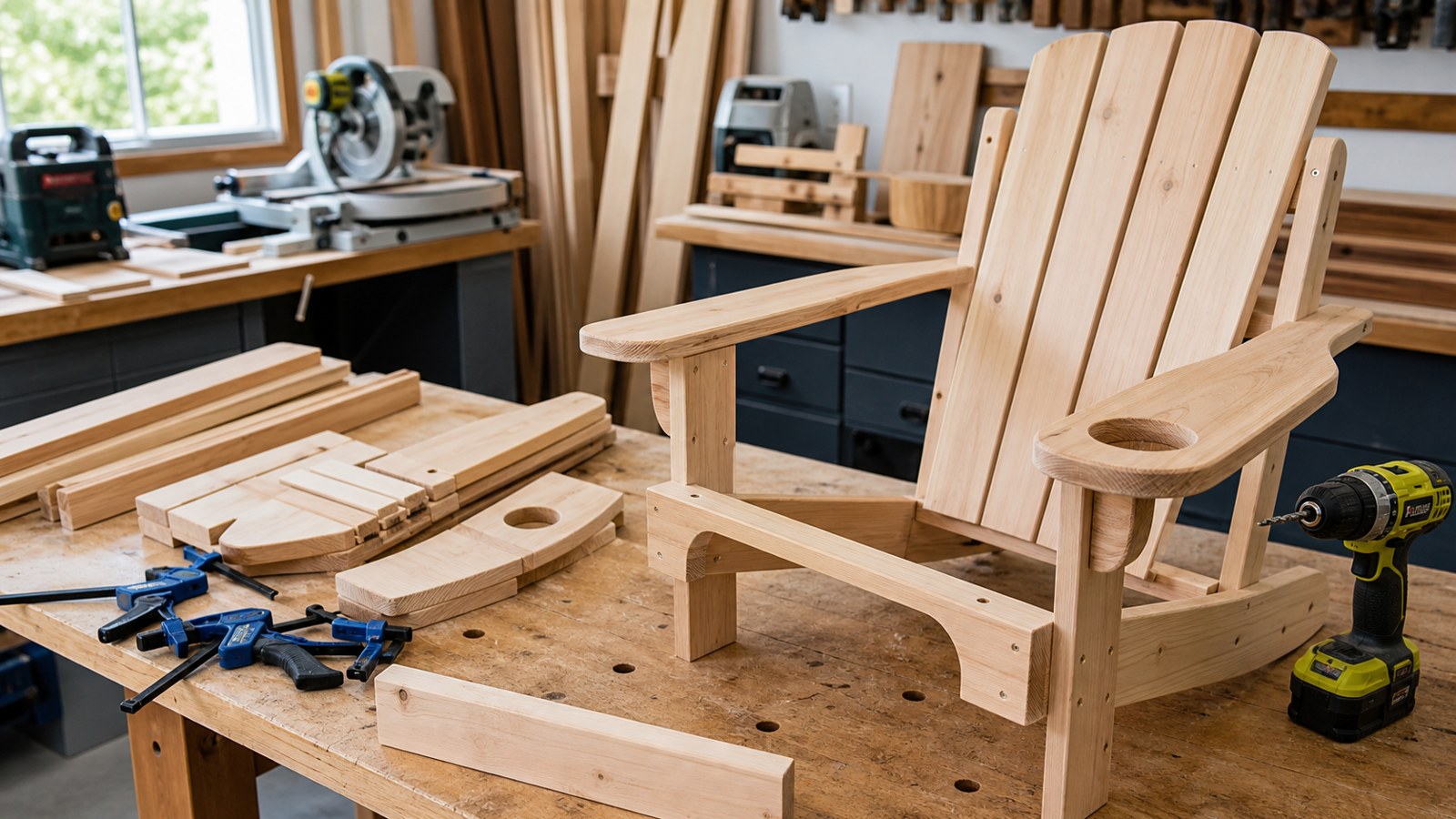
Crafting Relaxation, One Plank at a Time
Few DIY projects deliver the kind of satisfaction that comes from building your own Adirondack chair with a matching footrest. This iconic chair—known for its wide arms, reclined back, and deep seat—is more than outdoor furniture; it’s an invitation to slow down. Add a footrest, and you’ve elevated backyard lounging to pure serenity. Whether it’s for a lakeside deck, mountain cabin, or suburban patio, learning how to build an Adirondack chair with a footrest gives you a lasting, personal piece of craftsmanship that blends beauty, comfort, and function. In this guide, we’ll take you through every stage—from planning and materials to the final coat of protective finish—so you can confidently create your own classic chair, one step at a time.
A: Top ~20–22" W to match seat, depth 16–18"; height set so top sits ~1–2" below the seat front.
A: Cut two side profiles with a shallow 5–7° rise, add 4–5 slats with 1/8" gaps; round over front edge.
A: Separate is simplest; for link-ups, use small alignment cleats beneath the seat front (non-trip!).
A: Match the chair: HDPE for zero maintenance, cedar/teak for warm touch and patina.
A: Pigmented exterior paint or UV-resistant varnish; oil looks natural but needs quicker refresh cycles.
A: Wash, tighten hardware, scuff and refresh finish; check feet/glides for wear.
A: Add washers at bolts, re-square seat frame, shim glides; verify slat screws aren’t binding.
A: Increase lumbar arc slightly, widen arms to 5–6", add a head pillow; keep seat front well-rounded.
A: Consider a folding pattern with carriage-bolt pivots and slimmer arms.
A: Maintain 1/8" slat gaps, elevate on glides, and avoid trapping footrest under the seat where water pools.
1. Planning the Project: Visualizing Your Adirondack
Every successful woodworking project starts with a solid plan. Before you pick up a saw or screw, visualize the final look and setting of your Adirondack chair. Will it rest beside a garden path? Sit on a sunlit porch? Be part of a matching set? The environment helps determine material type, finish, and even subtle design adjustments.
Sketch your design or download a printable plan that includes precise dimensions for the seat, backrest, and footrest extension. Traditional Adirondack chairs measure about 36 inches high, 30 inches wide, and 35 inches deep, but the footrest adds roughly 20–24 inches of legroom.
Decide early if you’ll be staining or painting, because that choice affects your lumber selection. Cedar, redwood, and cypress are top choices for natural finishes, while pine or fir can be ideal for painted projects. The key is selecting wood that’s strong yet workable, able to resist moisture and sunlight.
2. Gathering Tools and Materials: Equipping Your Workshop
Before building begins, assemble all your tools and materials so the process flows smoothly. For one chair with a footrest, you’ll typically need:
- Lumber: About 6–8 boards of 1×4 and 1×6 weather-resistant wood (cedar, redwood, or treated pine).
- Fasteners: 1¼-inch and 2-inch outdoor wood screws.
- Wood glue: Exterior-grade for additional bonding.
- Sandpaper: Medium (120-grit) and fine (220-grit).
- Finish: Exterior paint, sealant, or stain of your choice.
- Tools: Jigsaw, circular saw, drill/driver, clamps, tape measure, carpenter’s square, pencil, and safety gear.
Having all materials pre-cut or marked before you start saves time and prevents misalignment later. Label your boards for each part—arms, back slats, seat, legs, and footrest supports—so you stay organized as the project progresses.
3. Measuring and Cutting the Pieces: Precision in Every Line
Accurate cuts are the backbone of a well-built chair. Begin by measuring and marking each component carefully according to your chosen plan.
Cut two back legs, each about 32 inches long, angling the rear edge at approximately 20 degrees to create that signature laid-back Adirondack posture. The front legs should be around 20 inches tall, with a squared bottom and angled top for attachment to the seat frame. Next, cut the seat slats (typically six to seven 1×4 boards) and back slats (five to six curved 1×6 boards). For the armrests, cut two 30-inch pieces, and for the footrest, cut a small frame of 20 inches deep and 22–24 inches wide. Use a jigsaw to shape the rounded tops of the back slats and the gentle curves of the seat edges. Smooth transitions make the chair more comfortable and visually refined. Remember—measure twice, cut once. Minor adjustments at this stage prevent headaches later in assembly.
4. Building the Base Frame: The Foundation of Comfort
The frame forms the skeleton of your Adirondack chair. Start by attaching the front and back legs using 2-inch screws, ensuring the angle between them forms a solid base capable of supporting weight. Position a cross-support between the legs to stabilize the structure.
Attach the seat supports at a downward angle of about 12–15 degrees from the front to the back—this gentle slope gives the chair its relaxed seating position. The front edge should sit roughly 14 inches above the ground, while the back edge will be around 9 inches high.
Once the supports are secure, check the symmetry of your frame with a square and level. The seat slats will soon rest on this foundation, so stability is critical. Apply exterior wood glue along each joint before screwing for added durability and a squeak-free finish.
5. Adding the Seat Slats: Laying the Heart of the Chair
With the frame sturdy, it’s time to attach the seat slats. Begin at the front and work backward, leaving a small ⅜-inch gap between each board for natural expansion and water drainage. Secure each slat with two screws at each end, sinking them just below the surface without cracking the wood. If your design includes curved seat slats, space them evenly to follow the contour of the supports. A good test is to sit briefly on the unfinished chair—if the angle feels natural and the boards don’t flex, your construction is solid. If not, adjust the spacing or add a hidden brace beneath the seat. This is the stage where your comfort truly takes shape.
6. Shaping and Attaching the Backrest: Lean Back and Relax
The Adirondack’s sloped back is its most distinctive feature. Arrange your pre-cut back slats on a flat surface, aligning them vertically with a slight curve at the top. Use a temporary brace across the middle to hold them in alignment.
Attach the bottom ends to a back support board, leaving consistent spacing between slats. Then, attach the backrest assembly to the rear of the seat frame, angling it backward about 15–20 degrees for ideal reclining comfort.
Secure the top and middle braces with screws, checking the feel by leaning back gently before tightening. The result should cradle your back naturally, distributing weight evenly rather than forcing an upright position.
Round any sharp edges with sandpaper to make it smooth to the touch—this extra step adds a professional, furniture-grade finish.
7. Installing the Arms and Supports: Signature Adirondack Style
No Adirondack chair is complete without its wide, inviting armrests. These are both functional and stylistic, serving as mini-tables for drinks or books. Attach the armrest supports first—one at the front leg and one at the back of the seat frame. The back support can connect directly to the upper backrest brace. Once those are firm, position each armrest on top and secure it with screws from underneath to hide the fasteners. Make sure both armrests are level with each other and extend slightly beyond the front leg for that classic overhang. You can round the front corners for a softer aesthetic or keep them squared for a modern look. This step visually transforms the project from “chair pieces” into a recognizable Adirondack—solid, stylish, and ready for finishing touches.
8. Constructing the Footrest: The Extension of Comfort
The footrest is the defining bonus feature that turns your Adirondack into an outdoor recliner. It’s essentially a low bench that slides up to meet the chair’s seat angle.
Cut two side rails approximately 20 inches long, each with a gentle upward taper that matches the chair’s incline. Then cut several 1×4 slats to serve as the footrest top. Assemble by screwing the slats across the rails, leaving small gaps for water drainage.
Once built, the footrest can remain a separate piece or be attached via hinges for a fold-away option. If you prefer mobility, keep it detachable so you can use it as a small table or stool when not lounging.
For a seamless look, match the spacing, width, and finish of the footrest slats to your chair’s seat.
9. Sanding and Smoothing: Preparing for Perfection
Before finishing, sanding is essential. Start with medium-grit (120) sandpaper to remove rough surfaces, tool marks, or splinters. Work along the grain to avoid scratches. Follow with fine-grit (220) sandpaper for a silky touch, especially on armrests and seat edges. Wipe away dust with a tack cloth. Pay attention to corners, joints, and curved sections—these areas see the most contact and deserve extra care. Proper sanding not only enhances comfort but ensures that paint or stain adheres evenly. This stage is where raw lumber transforms into furniture. You’ll feel the tactile difference immediately: smooth, inviting, and ready for that first sunny afternoon of use.
10. Finishing Touches: Staining, Painting, or Sealing
A well-chosen finish defines your chair’s character and protects it from the elements. You have three main options—stain, paint, or clear sealant—each offering distinct advantages.
If you love the natural grain of cedar or redwood, a penetrating oil-based stain accentuates texture while adding UV protection. For a bold, colorful look, outdoor paint allows creativity—try classic white, nautical blue, or forest green. If you prefer minimal alteration, a clear marine varnish or polyurethane keeps the wood looking natural but safeguarded.
Apply finish with a brush or sprayer in long, even strokes, following the grain. Let each coat dry fully before adding the next, typically two to three coats for optimal coverage.
Finishing isn’t just about aesthetics—it extends the life of your Adirondack chair, making it weather-resistant for years of backyard comfort.
11. Assembly Check: Final Fit and Function
Once the finish dries, reassemble or tighten all joints. Test the chair’s stability on level ground, adjusting any legs or supports if there’s a wobble. Set the footrest in place and ensure it aligns smoothly with the chair’s seat angle. Sit down and relax—the test of craftsmanship is comfort. If it feels balanced and the recline feels natural, you’ve built an Adirondack worth showing off. A quick tip: mark the undersides of removable parts (like the footrest) with discreet notches or initials. It helps when reassembling after seasonal storage or refinishing.
12. Optional Upgrades: Customizing Your Creation
Once you’ve mastered the basic build, personalization becomes the fun part. Consider these creative upgrades:
- Cup holder or side tray: Cut a small circular recess into one arm or attach a folding side tray for beverages.
- Cushions: Sew or buy fitted cushions in weatherproof fabric for extra comfort.
- Carving or engraving: Add initials, dates, or a simple design to the backrest for a personal touch.
- Color blocking: Paint the footrest or arms in contrasting hues for a coastal or cottage vibe.
Customization turns your Adirondack chair from a DIY project into a signature piece of outdoor art—functional and uniquely yours.
13. Maintenance and Longevity: Keeping It Perfect Season After Season
Even the best-built chair benefits from seasonal care. Keep your Adirondack looking beautiful with a few maintenance habits. Clean the surface regularly with mild soap and water to remove pollen and debris. Every year or two, lightly sand and re-coat with your chosen finish to refresh protection against UV rays and moisture. During harsh winters or extended rain periods, store your chair in a shed or under a waterproof cover. Elevate it off the ground slightly to avoid moisture buildup. If you used stainless steel or coated screws, rust shouldn’t be an issue, but check occasionally for loosened hardware. A quick tightening keeps the structure solid and creak-free for years of use.
14. Understanding the Adirondack Legacy: From Mountains to Modern Patios
The Adirondack chair’s story traces back to the early 1900s when Thomas Lee, vacationing in the Adirondack Mountains of New York, sought the perfect outdoor chair for uneven terrain. His design—a slanted seat, fan-back support, and wide armrests—was both practical and comfortable, soon becoming a symbol of leisure.
Today, the design has evolved with countless variations: folding versions, composite materials, and even ergonomic updates. Yet the spirit remains the same—simplicity, relaxation, and craftsmanship.
By building your own, you join a long tradition of makers who appreciate the balance between nature, function, and artistry. The addition of a footrest honors that legacy while tailoring it to modern comfort standards.
15. Troubleshooting Common Mistakes
Every project has its challenges. Here’s how to spot and fix common issues before they become frustrations. If your chair wobbles, check the leg lengths and sand down the longest one until balanced. If the back feels too upright, you may need to adjust the attachment angle of the backrest—just a few degrees makes a big difference. Cracked wood often indicates over-tightened screws or drilling too close to edges. Pre-drill all holes to prevent splitting. And if your finish looks uneven, lightly sand and apply a thin second coat rather than trying to cover it with a heavy layer. These small corrections ensure your final product is both sturdy and beautiful, worthy of your effort and time.
16. Enjoying the Result: The Art of Sitting Still
When the sawdust settles and the paint dries, the reward is pure satisfaction. Place your new Adirondack chair on the patio, under a shade tree, or beside a lake and take that first seat. Feel the sloped backrest cradle you, rest your feet on the matching footrest, and let the craftsmanship sink in.
There’s something timeless about building something with your hands—a blend of patience, skill, and creativity that no store-bought chair can replace.
Your Adirondack chair isn’t just furniture; it’s a personal symbol of rest, reflection, and accomplishment.
Build Once, Enjoy for Years
Building an Adirondack chair with a footrest is a journey in craftsmanship and comfort. From the first board cut to the final brush of varnish, each step shapes not only a piece of furniture but also a rewarding creative experience. With simple tools, thoughtful planning, and attention to detail, you can craft a piece that embodies both rustic tradition and modern relaxation. The next time you settle into your handmade chair—coffee in hand, feet up, and sun warming your shoulders—you’ll appreciate not just how it looks, but how it feels to create something enduring and uniquely yours. An Adirondack chair with a footrest isn’t just a seat; it’s a handcrafted destination for every peaceful moment that follows.