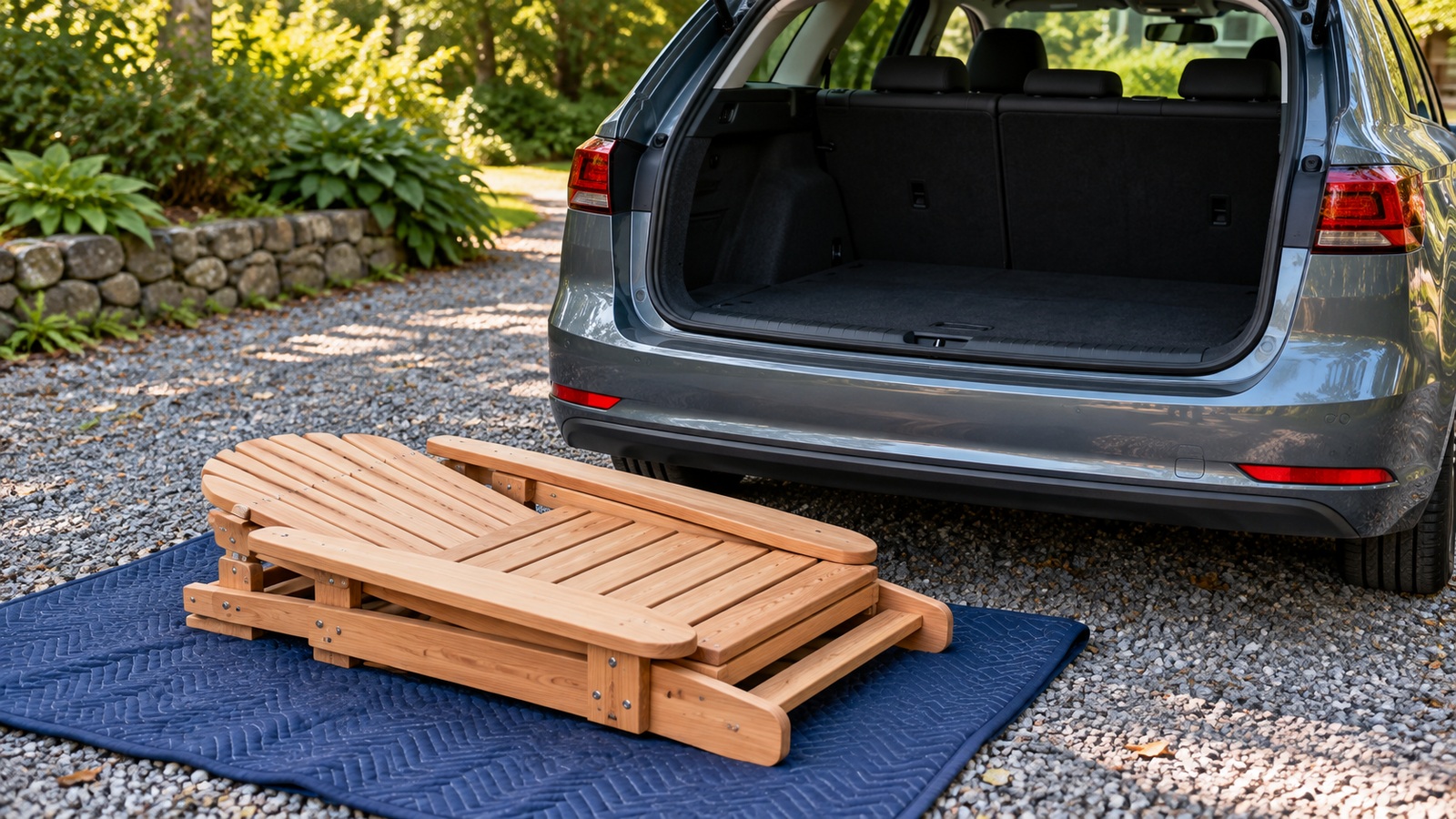
Fit Depends on the Opening as Well as the Trunk
A folding Adirondack chair can be easier to transport than a rigid model, but folding does not guarantee that it will fit in a car trunk. The chair still has a width, length, thickness, and weight, and the vehicle has an opening that may be narrower than the space behind it. Arms, wheel wells, hinges, and the shape of the back can make a simple comparison of two advertised measurements misleading. The useful approach is to check the exact folded chair against the exact vehicle, including the route into the cargo area and the way it will be carried securely. That turns a broad shopping claim into a practical test. It also helps determine whether a folding Adirondack is the right portable seat for a particular trip.
A: No. Folded shape and the exact vehicle opening determine the comparison.
A: No. A carton may contain disassembled components and is not the assembled folded chair.
A: Volume does not describe the opening, projections, or turning route.
A: No. Thickness and the complete moving shape still need consideration.
A: Ask how the model folds and which protrusions are included in the measurements.
A: Use only procedures the manufacturer permits for that model.
A: The removal movement and available help may differ from loading at home.
A: Use the vehicle's guidance and suitable equipment for the actual load.
A: No. Multiple chairs require a complete new load comparison.
A: When frequent handling, cargo space, or trip conditions outweigh the Adirondack lounge experience.
Get the Folded Dimensions for the Exact Model
Product pages often emphasize the dimensions of an open chair because those measurements help with patio placement. Transport requires a different set of information. Ask for the complete folded dimensions and confirm how they are measured. The answer should include protruding arms or other parts that remain outside the main folded profile.
Make sure the dimensions refer to the assembled chair in its approved folded position. Shipping-carton dimensions describe a different object and may include disassembled components. A product that arrives in a small box can still become a bulky chair after assembly. Do not use its packaging size as evidence of car fit.
Measure the Narrowest Point on the Loading Route
A trunk’s interior can offer generous space behind a relatively small opening. Measure the usable opening and look for curves or projections that reduce it. Then inspect the route from the opening to the proposed resting position. The chair must pass through the whole route without forcing parts against the vehicle.
Hatchbacks and wagons can provide different access from a sedan, but body style alone does not settle the result. Rear trim, wheel wells, seat positions, and cargo-floor shape vary among vehicles. Use the actual car rather than assuming that all vehicles in a category offer the same opening. Even a familiar model name can refer to vehicles with different body configurations or generations. A friend’s successful load is therefore useful only as an example of their arrangement. If you borrow or hire another vehicle, repeat the relevant measurements and review its loading guidance. A change in the cargo floor or opening can alter the task even when the new vehicle appears larger from outside. Measurements are useful only when connected to the specific arrangement.
Include the space occupied by other luggage and the passengers who must travel. A chair may fit when the cargo area is empty but become impractical on the intended trip. Plan the whole load rather than treating the chair as the only item. A realistic comparison can prevent a last-minute choice between furniture and essential belongings.
Understand What Folding Changes
Some Adirondacks fold by bringing the seat and legs closer to the back while leaving broad arms largely unchanged. Others have a different mechanism and profile. Examine photographs or a demonstration of the folded state. The word folding tells you that a mechanism exists, not that every dimension becomes small.
The POLYWOOD Classic Folding Adirondack product information, for example, distinguishes its open sitting position from its folded storage position. That is a model-specific design description, not a promise about your trunk. Use a maker’s folding guidance to identify the correct state before making your own vehicle comparison.
Check whether loose pins, accessories, or removable cushions are involved in the approved process. These items need their own place during transport. A missing part at the destination can prevent normal use even when the chair traveled successfully. Keep the instructions with the furniture until the handling sequence is familiar.
Do not plan to remove structural components unless the manufacturer explicitly permits the procedure. Improvised disassembly can add time, lose parts, or change the chair’s condition. A folding design should be evaluated in the state intended for routine handling. If that state does not fit the car, compare another transport arrangement or seat type.
A Diagonal May Help, but It Is Not Proof
Angling a chair can sometimes change how it passes through an opening, yet a single diagonal measurement does not establish the full result. The folded shape has thickness, protrusions, and a turning path as well as length. Test the orientation without forcing the chair or vehicle trim. If a careful trial is unavailable, leave a realistic margin and ask for more detail rather than promising yourself that a mathematical diagonal will solve an uncertain fit. An item that barely passes an opening can still be difficult to place and remove safely.
Weight and Grip Affect Practical Portability
A chair can fit geometrically while remaining awkward to load. Compare its weight with the handling task and the people available to help. Broad folded surfaces may be difficult to grip, and lifting into a trunk can require a different movement from carrying across a patio. Treat practical portability as more than a compact outline.
Use the manufacturer’s handling instructions and identify suitable gripping points. Keep fingers clear of moving parts and do not assume that an arm or decorative slat is intended to carry the whole load. If the task is awkward, arrange assistance. A convenient folding mechanism does not eliminate the need for a manageable lifting process.
Consider how often the chair will make the journey. Occasional relocation may justify a larger, heavier lounge chair, while frequent day trips may call for a lighter portable alternative. The right decision depends on the pattern of use. A chair that spends most of its time at home does not need to win every transport comparison. Think through where the folded chair goes between the vehicle and its final seat. A long gravel path, stairs, or a narrow garden gate adds handling beyond the trunk opening. These conditions can change whether the transport feature is useful for the intended destination. Include them in the trial when possible rather than ending the comparison at the moment the chair leaves the car.
Protect the Furniture Without Hiding a Fit Problem
A suitable protective layer can reduce contact between the chair and cargo-area surfaces. Account for its thickness when testing the load. Padding should not be used to wedge an uncertain object into place or conceal a poor fit. The chair needs an appropriate resting position and transport arrangement beyond surface protection.
Remove dirt and ensure the chair is suitably dry before loading, following its care guidance. Debris can make the vehicle harder to clean and obscure damage on the furniture. Inspect the folded chair before the trip so a problem is not discovered only after unloading. Keep separate accessories from rubbing against surfaces unnecessarily.
Check whether any protruding fastener or damaged edge might catch on interior trim. An issue that appears minor at home can complicate the loading route. Address damage appropriately before transport rather than wrapping it and hoping it stays contained. Protective materials are most useful around a sound, suitable item.
At the destination, retain the protective layer in a practical location if it will be needed for the return journey. A transport plan has two loading events, not just the first one. Keeping the arrangement repeatable reduces the chance of an improvised return load. It also makes the chair easier to inspect between trips.
Plan Cargo Security Using the Vehicle’s Guidance
Furniture inside a vehicle needs an appropriate cargo arrangement. Consult the owner’s manual for loading limits, seat configuration, and the use of any designated securing points. Do not assume that a chair is secure because it sits snugly between bags. Its position should not interfere with passengers, controls, visibility, or the vehicle’s normal operation.
Use suitable equipment and a method appropriate to the vehicle and load. This article cannot establish a universal tie-down arrangement for every trunk and chair shape. If the intended load cannot be carried appropriately, choose another transport option. A successful fit test includes the practical ability to complete the trip safely.
Try the Full Journey Before Relying on It
When possible, test loading with the actual folded chair before committing to a purchase or an important trip. Confirm return conditions if a home fit trial is part of the plan. Use the expected seat configuration and ordinary luggage. This reveals issues that a showroom demonstration or isolated measurement can miss.
Unloading deserves the same trial. A chair that can be inserted with help and careful rotation may be difficult to remove alone at a remote destination. Check the grip, clearance, and turning space on the return path. Practical fit should work in both directions without forcing components.
After opening the chair, inspect and engage every mechanism as directed before use. Transport may expose a missing part or damage that was not apparent when folded. Set it on a suitable surface and check its condition. Do not treat arrival as confirmation that the furniture is ready for sitting.
Compare Alternatives Without Forcing the Adirondack Choice
Folding Adirondacks can provide a familiar lounge experience at a cabin, campsite, or holiday rental when transport works. They are not the only way to bring outdoor seating. A conventional portable chair may make more sense when cargo space and frequent handling are the dominant concerns. Choose around the trip rather than around a desired label.
If the Adirondack will remain at the destination for a season, delivery or another planned vehicle may be more practical than repeated trunk transport. Compare the complete task, including carrying, storage, and return arrangements. Avoid assuming that a folding model must travel by car simply because it can fold. The mechanism can also serve household storage.
Buying one suitable chair before arranging a larger group can reduce uncertainty. Multiple folded chairs introduce a separate packing problem, even when one fits easily. Verify the complete proposed load before expanding the purchase. A successful single-chair test is useful evidence, but its scope should remain clear.
Keep a record of the model and vehicle arrangement that worked. Include folded orientation, accessory placement, and any help needed for loading. This is a practical reminder rather than a guarantee for another car or a revised chair model. Recheck when either part of the arrangement changes.
Turn the Trunk-Fit Claim into a Measured Decision
Start with exact folded dimensions, then examine the opening, interior route, and final cargo arrangement. Add weight, grip, luggage, and manufacturer handling instructions to the comparison. Those details give the phrase fits in a car trunk a meaningful basis. They also reveal when another seat or transport method would serve the trip better.
A folding Adirondack is portable when the complete handling task works for its owner. It needs to enter, travel, leave the vehicle, and return to sound sitting condition without improvised steps. A careful trial offers a more dependable answer than a broad claim about cars. With that evidence, you can choose a chair for the journey as well as for the view at its destination.