
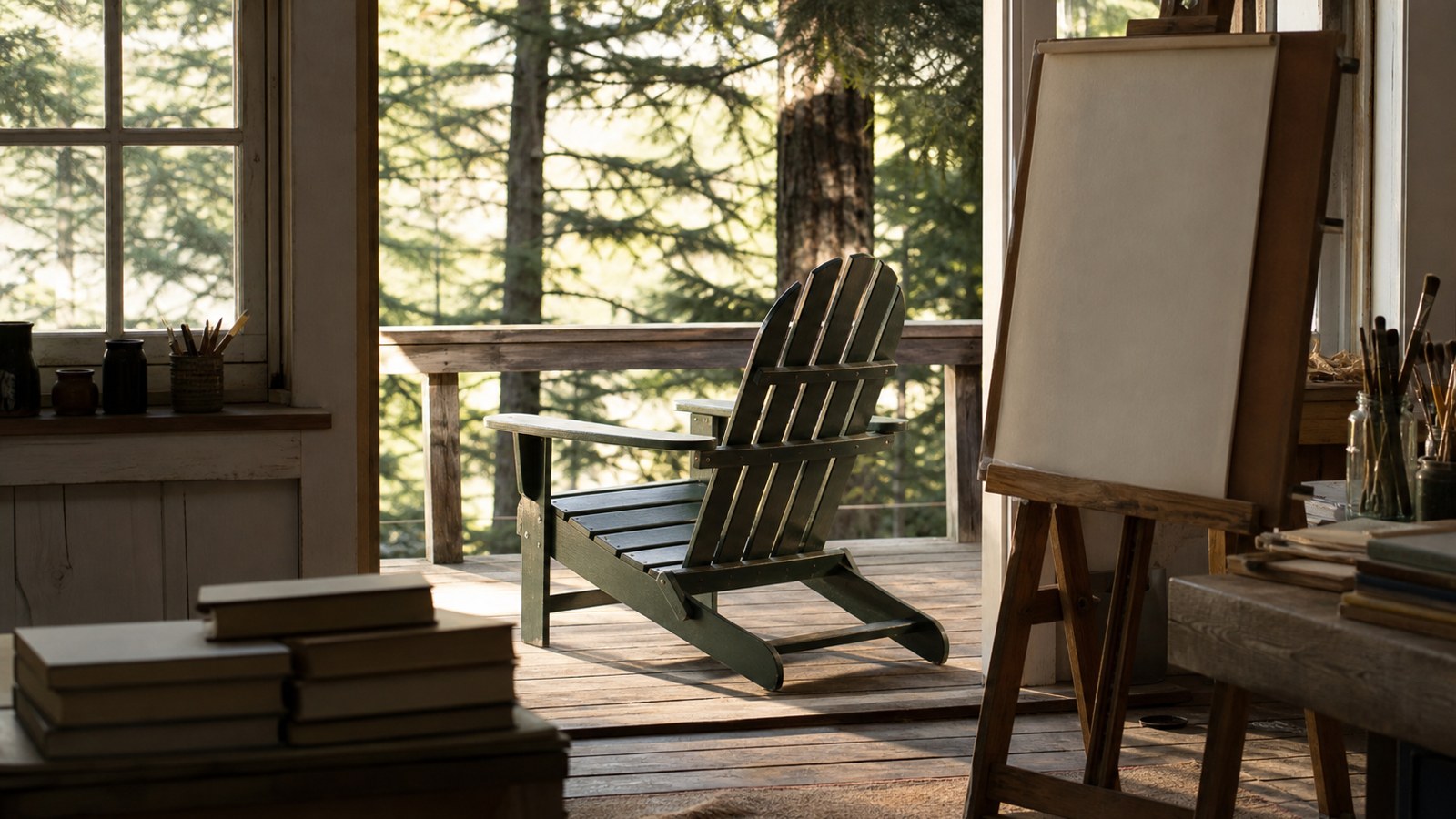
A Chair That Carries a Scene
Adirondack chairs appear in American literature and art less as technical furniture and more as shorthand for a certain kind of place. A single sloped chair on a porch can suggest summer, retreat, family memory, solitude, regional pride, or the boundary between domestic life and wild landscape. Writers and artists are drawn to objects that carry atmosphere efficiently, and the Adirondack chair does exactly that. Its silhouette is specific enough to be recognizable, but open enough to hold many meanings. In a painting, photograph, memoir, novel, or travel essay, it can be a seat, a symbol, a compositional anchor, and a quiet invitation to imagine who has just left the frame. That ability to imply a human story without showing every detail is what gives the chair unusual creative range. It also lets the chair move between high and everyday culture: the same form can belong in a family snapshot, a regional watercolor, a magazine spread, or a quiet scene in a novel without feeling out of place. Its plain construction leaves room for interpretation, which is why the chair can feel personal even when it is drawn, painted, or photographed as a simple object. The viewer supplies memory, and the chair gives that memory a place to sit. In that exchange, furniture becomes atmosphere rather than inventory, especially in scenes shaped by quiet outdoor attention.
A: It suggests that someone belongs in the scene, which lets viewers imagine presence, absence, waiting, or return.
A: It began with strong regional associations, but its use across patios, resorts, and art has made it broadly American.
A: The sloped seat, broad arms, and fan back create a clear shape that reads well in paint, print, and photography.
A: Yes, especially when isolated, out of season, or paired with signs of recent use.
A: Absolutely. Warm light, paired chairs, cushions, and open views can make the same form feel deeply welcoming.
A: They let it support action, memory, and setting rather than stopping the story to describe furniture.
A: Very much. White can feel coastal, red can feel nostalgic, green can feel woodland, and weathered gray can feel reflective.
A: It lets the viewer picture rest, scenery, and ownership of a quiet outdoor moment.
A: No. Modern materials and bold settings can make it feel current, graphic, or even sculptural.
A: The chair needs a reason to be there, whether that reason is a view, a porch, a season, or a human ritual.
The Object as Atmosphere
Some objects enter art because they are beautiful. Others enter because they carry a world with them. The Adirondack chair does both, but its real strength is atmospheric. Place one in a scene and the viewer immediately senses leisure, landscape, and the possibility of reflection. The chair is not neutral. It brings weather, season, porch boards, lake air, and unhurried time into the frame.
That makes it useful for American storytelling. Literature and visual art often depend on ordinary objects that can hold emotion without announcing it. A chair can be empty, occupied, freshly painted, abandoned, inherited, moved into shade, or left facing a view. Each version changes the meaning of the scene while remaining believable.
The chair’s familiarity also gives creators a shortcut into mood. A writer does not need to explain an entire vacation culture if one sentence places a faded Adirondack chair at the edge of a porch. A painter does not need a crowded scene if the chair already implies a human body, a season, and a reason to look outward. The object carries enough context to make restraint possible.
Porches, Thresholds, and the Edge of Wilderness
The Adirondack chair often sits at a threshold. It belongs on porches, decks, docks, lawns, and camp edges, where domestic life meets open air. That position gives it symbolic flexibility. It can represent safety because it is part of home, but it can also represent exposure because it faces the weather and the woods.
In writing, that threshold can support inner conflict. A character seated outside may be close to family voices behind them and still mentally elsewhere. A chair facing a lake can make thought visible because the reader understands the direction of attention. The landscape becomes part of the character’s interior life.
Artists use the same threshold visually. The hard geometry of the chair contrasts with trees, water, and sky. Porch shadows organize the composition, while the chair’s angle points beyond itself. The viewer is invited to occupy the seat and look outward.
Because the chair belongs neither fully inside nor fully outside, it can hold mixed feelings gracefully. A scene can be domestic and wild, social and solitary, nostalgic and unsettled. That complexity is valuable in American art, where home and landscape are often intertwined but rarely simple.
The Empty Chair and the Power of Absence
An empty Adirondack chair is one of the form’s strongest images. It can be peaceful, expectant, lonely, comic, or elegiac depending on context. A single chair by a dock may suggest solitude. Two chairs with one slightly turned away may imply conversation interrupted. A faded chair after summer can carry the weight of departure without showing a person at all.
This is why the object suits book covers, personal essays, and regional photography. It gives absence a shape. It lets the audience ask who was there, who is missing, and whether the moment is open or already gone.
Absence becomes especially strong when the chair bears small signs of use. A towel over one arm, a cushion shifted from its usual position, or a cup ring on a broad arm can suggest that a person has only just stepped away. In a literary scene, those details can hold grief, suspense, tenderness, or humor without forcing the narrator to name the feeling directly.
Color as Narrative
Color changes the chair’s role quickly. A white chair can feel coastal, clean, and traditional. A green chair can disappear into woodland settings until light catches the arm. Red can feel nostalgic or festive, especially against snow, weathered siding, or dark water. Bright blues and yellows can signal family cottages, rental cabins, and contemporary outdoor rooms.
In art, color can separate the chair from realism. A painter might choose a saturated shade because it anchors the canvas. A photographer might use a muted tone so the chair does not compete with the view. A writer might mention paint peeling from the arm because that single detail reveals age, care, or neglect.
The important point is that Adirondack chairs rarely feel colorless in cultural imagination. Even when unstained or gray, they carry a finish, and that finish becomes part of the story.
Color can also date a scene. A particular green may feel like a state-park lodge, while a sun-faded turquoise may suggest a midcentury lake cottage. A new matte black chair can make the same setting feel more designed and contemporary. These color associations are not fixed rules, but they give artists and writers a subtle way to place a story in time.
Regional Roots and American Spread
The name Adirondack gives the chair a strong regional anchor, but the object’s meaning has traveled far beyond one mountain region. It now appears on suburban patios, coastal decks, desert rentals, ski lodges, city balconies, and resort lawns. That spread makes it both specific and adaptable.
For artists and writers, this is useful tension. The chair can evoke the northeastern outdoors, yet it can also express a national dream of having a private place to sit outside. It belongs to camps and cabins, but it also belongs to home improvement catalogs and vacation photographs. Its identity is regional, commercial, personal, and nostalgic at once.
That layered identity helps explain why the chair keeps returning in visual culture. It can stand for a named place, but it can also stand for the more general American desire to claim a small piece of outdoor quiet. The chair is specific enough to avoid vagueness and broad enough to welcome many viewers into the scene.
How the Chair Frames the Body
Adirondack chairs affect how bodies appear in images and scenes. A person seated in one is usually not perched forward in alert formality. They are reclined, open, and grounded. That posture changes dialogue, silence, and composition. It suggests that time has widened.
This can be tender or tense. Two characters sitting side by side may avoid looking directly at each other, which can make conversation easier or more evasive. A figure sunk low into a chair may seem relaxed, withdrawn, aging, or finally at rest. The same posture can mean different things depending on the surrounding story.
Because the chair is visually large, it also gives the body a frame. Arms, slats, and the angled back create a structure around the seated person. That structure can feel protective or confining, another reason the object works well in narrative art.
The posture also changes pacing. Scenes in these chairs tend to resist hurry. A character must push forward to stand, shift weight, and leave the comfortable angle behind. That simple physical fact can make a departure feel reluctant, a confession feel delayed, or a peaceful pause feel earned after motion.
Modern Uses in Photography and Illustration
Contemporary lifestyle photography uses Adirondack chairs because they perform a scene efficiently. A pair of chairs facing a view suggests a destination even without people. A chair beside a fire pit suggests evening gathering. A chair on a snowy porch suggests seasonal endurance. The object becomes a stand-in for the viewer’s future experience.
Illustration can push the form even further. The slats can become graphic lines, the arms can become flat color planes, and the back can echo sunbursts, pine branches, or lake ripples. The chair remains readable even when simplified, which is valuable for posters, book jackets, and decorative prints.
Commercial images sometimes overuse the chair as instant shorthand, but the strongest images still give it a believable relationship to place. The legs sit squarely on a real surface, the view explains the orientation, and the surrounding objects support a human ritual. When that grounding is missing, the chair becomes a prop. When it is present, the image feels lived in.
Reading the Chair Without Overloading It
The chair works best when its meaning is allowed to remain partly open. If every symbolic possibility is explained, the scene becomes heavy. If the chair is simply placed with care, it can gather meaning from season, color, view, and use. That restraint suits both visual art and prose.
A writer might mention the chair only once, but place it at the exact moment a character returns home. A photographer might leave the chair empty and let fog over the lake do the emotional work. A painter might exaggerate the angle of the back until it feels almost like a gesture. Each choice depends on trust that viewers already know something about the object.
That shared recognition is a cultural advantage. The Adirondack chair does not need ornate carving or luxury materials to matter. Its plainness lets it absorb the life around it, which is why it can move from illustration to memoir to gallery wall without losing its identity.
For creative work, the lesson is simple: use the chair as an anchor, not an explanation. Let the setting, light, and human trace complete the meaning.
Why It Endures as a Cultural Image
The Adirondack chair endures because it is ordinary enough to be personal and distinctive enough to be symbolic. It can hold a memory without becoming sentimental by default. It can sit in the background of a family story or stand alone as the subject of an image.
In American literature and art, that flexibility matters. The chair can mean retreat, status, labor, maintenance, inheritance, vacation, quiet, loss, or return. Its best appearances do not explain all of that. They simply place the chair where it belongs and trust the audience to feel the rest. Few furniture forms can be so plainly useful while carrying so much emotional weather, and that is why the shape keeps reappearing whenever creators want leisure to feel particular rather than generic.


